
Insights
Before the meeting starts: notice, agenda and minutes for Texas public bodies
A Houston appeals court ruled in 2025 that a county budget item did not give notice of a department split. What a Texas public body covered by the Open Meetings Act must post, when and where, and what the minutes must show.
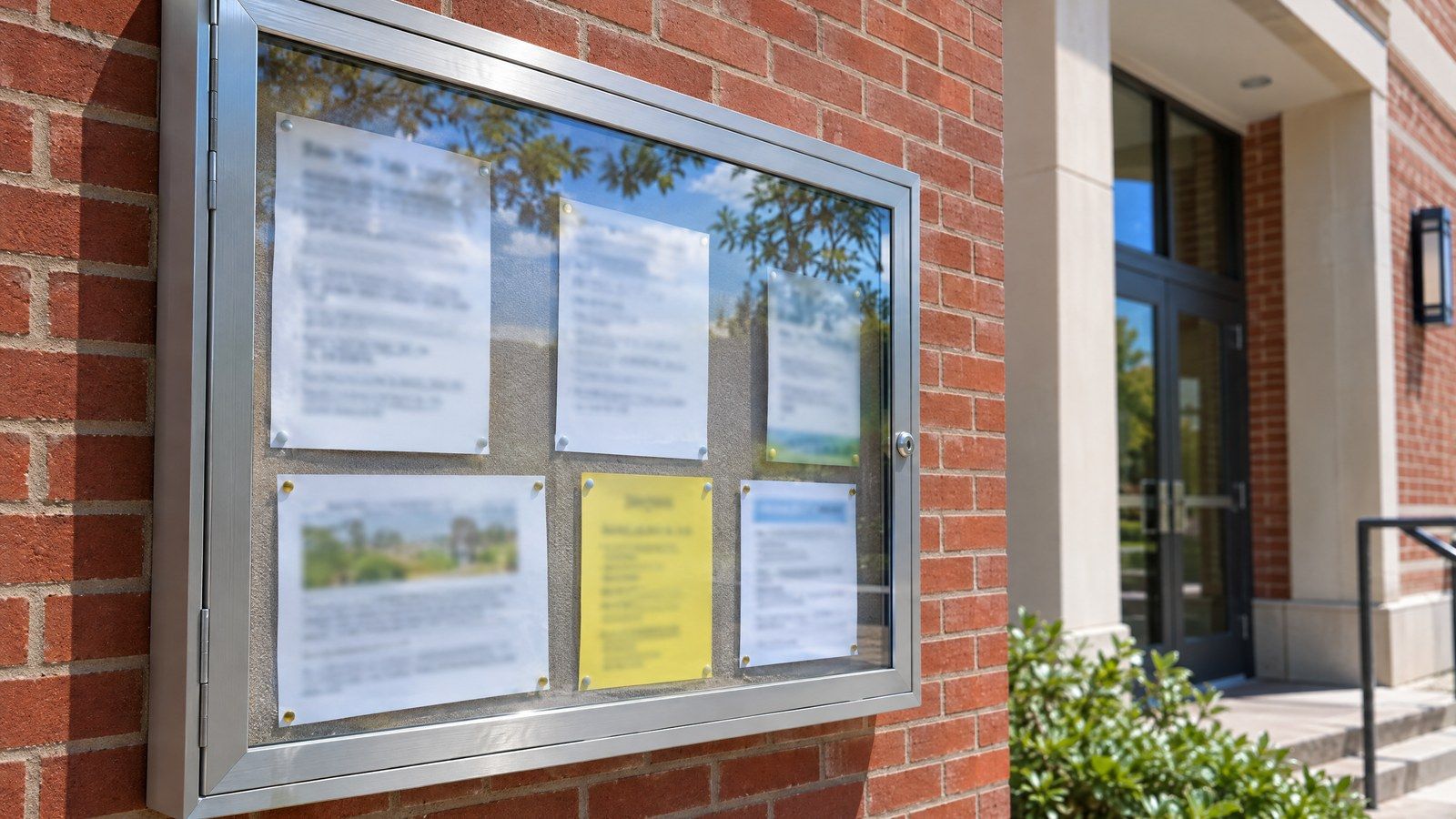
Many challenges to a public body's decision turn on a simpler question than the merits: did the public know it was coming? Under the Texas Open Meetings Act, every governmental body, whether a city council, a commissioners court, a school board, a special district board or a city board with rulemaking power, gives written notice of the date, hour, place and subject of each meeting.1 That notice, and the record kept afterward, are a big part of what lets a vote stand up if it is challenged. A recent case shows how one agenda item can decide that.
One budget item, one department split
In September 2016 the Webb County Commissioners Court took up its budget for the coming fiscal year. Item 49 on a sixty-item agenda announced discussion and possible action to adopt the budget and said the court could make any modifications to the proposed budget warranted by law and the interest of the taxpayers. During that item, the court voted to split its Administrative Services Department into two new departments, Human Resources and Risk Management, and moved the department's director into one of them at a lower salary.2
The director sued under the Open Meetings Act. In a substitute opinion issued November 13, 2025, the Fourteenth Court of Appeals in Houston held that the notice fell short.2 The court did what courts usually do in these cases: it laid the posted notice next to what actually happened at the meeting. The budget item never mentioned restructuring a department. The court noted that when other job descriptions changed at the same meeting, such as custodian and maintenance positions, the county had posted separate items for them. Administrative Services was the only department divided in two at the meeting. A resident reading Item 49, the court concluded, would have had no clue a department was about to be divided.2
The court also ruled that the director could not recover back pay or lost retirement benefits through an Open Meetings Act claim, but it upheld the violation and the award of her attorney's fees.2 For whoever writes the agenda, the lesson is narrow and practical. A broad item covers the routine business inside it. A change the public would care about gets its own words.
What the notice has to say
The law asks for four things: date, hour, place and subject.1 The subject is where the trouble starts. The Texas Supreme Court first found a notice inadequate in 1986, when it held that an Austin school board's notice listing only "personnel" and "litigation" did not tell the public the board would choose a new superintendent.3 A notice does not have to list every consequence of an item; it has to alert a reader that some action will be considered on that topic.4 Matters of special interest to the public, such as a top hire or a charter change, call for more detail than routine business.4
A few patterns come up again and again in the Attorney General's handbook. Catch-all labels such as "new business" or "other business" give no notice at all. Where a body's agendas usually say "discussion and possible action" for items it may vote on, an item that says only "discussion" may not give notice that the body could act on it. Closed sessions need their subjects listed too; a standing line reserving the right to go into executive session is not enough on its own.4
When and where it is posted
Since September 1, 2025, the notice must be posted for at least three business days before the scheduled date of the meeting.1 Counting those days, including what to do when a holiday closes the office during the window, is worth settling with your attorney once and writing into your calendar.5 State bodies with statewide reach post through the Secretary of State at least seven days ahead.1
The emergency exception is narrow. A body may post as little as one hour ahead only when immediate action is required because of an imminent threat to public health and safety or a reasonably unforeseeable event such as a fire, flood, storm, power failure or epidemic. The notice must name the emergency. At that meeting the body may act only on matters tied to the emergency and on items that were already on the posted agenda.1 Courts review these claims; one court found that dismissing a city manager was not an urgent public necessity.4
Where to post depends on the type of body. A city posts at city hall, a county on a bulletin board at the courthouse or on an electronic display allowed by Local Government Code section 82.051, and a school district at its central administrative office. Other districts and political subdivisions post at their administrative office and either send the notice to the county clerk or post it on their own website. A district in fewer than four counties sends it to the clerk of each county it covers. A district in four or more counties sends it to the clerk of the county where its office is, and also to the Secretary of State.1 Cities, counties, school districts, junior college districts, development corporations and certain other districts and authorities named in section 551.056 that have websites must also post the notice and the agenda there at the same time.1 When a notice for a budget meeting is posted, it must include the proposed budget, unless the budget is clearly accessible on the home page of the body's website, along with a taxpayer impact statement.1
Consistency matters as much as placement. In one South Texas city, the notice outside city hall was marked "cancelled" while the copies online and inside were not, and the council met anyway. The court held the notice violated the Act.4
The record after the meeting
Every governmental body keeps minutes or makes a recording of each open meeting. Minutes must state the subject of each deliberation and show each vote, order, decision or other action taken.1 Minutes and recordings are public records, available on request to the body's chief administrative officer or that officer's designee.1 A closed session needs a certified agenda or a recording, except for a consultation with the body's attorney, and it is kept at least two years.4
Some bodies have added duties. Since September 1, 2025, independent school district board minutes must show each trustee's attendance and vote, the minutes go on the district's website, and every regular or special meeting is recorded.4 The elected councils of home-rule cities of 50,000 or more, commissioners courts in counties of 125,000 or more and elected school boards in districts with 10,000 or more students must record their regularly scheduled meetings on video, post each recording online within seven days and keep it there for at least two years.1,4 Beyond that, minutes, notices and agenda packets are government records kept under the Texas State Library and Archives Commission schedules.4
When something goes wrong
An action taken in violation of the Act is voidable, and a court may set aside only the action that lacked proper notice. In one school district case, "personnel" was too vague for hiring three principals but enough for a librarian, teachers and a band director, so only the principal hires were voided.4 Any interested person, including the news media, can sue to stop or reverse a violation, and the court may award attorney's fees.1,4 A body can ratify a flawed action at a later, properly noticed meeting, but the ratification counts only from that date and the new notice has to cover the action being ratified.4
A checklist for the person who posts the agenda
- Count back three business days from the meeting date, skipping weekends and any day your office is closed, and post before the deadline.
- Read each item as a resident would. Would they know what may be decided?
- Give its own item to anything of special public interest: a top hire, a reorganization, a fee or tax change, a charter question.
- Say "discussion and possible action" wherever a vote may happen, and use that wording the same way every time.
- List each closed-session subject, not just a general reservation.
- Post in every place the law names for your type of body, and on the website if yours is one that must.
- Keep a dated copy or screenshot of every posting.
- Before adjourning, confirm the minutes or recording will capture each subject and every vote.
The rules are short, and in the cases above the problem came down to a few words on one agenda item. Write every item for the resident who reads nothing else.
Reviewed against Texas law as of November 2026.
Want to cite this article?
GovLeaders Academy. (2026, November 7). Before the meeting starts: Notice, agenda and minutes for Texas public bodies. https://learn.govleadersacademy.com/insights-before-the-meeting-starts-notice-agenda-minutes
“Before the Meeting Starts: Notice, Agenda and Minutes for Texas Public Bodies.” GovLeaders Academy, 7 Nov. 2026, learn.govleadersacademy.com/insights-before-the-meeting-starts-notice-agenda-minutes.
GovLeaders Academy. “Before the Meeting Starts: Notice, Agenda and Minutes for Texas Public Bodies.” November 7, 2026. https://learn.govleadersacademy.com/insights-before-the-meeting-starts-notice-agenda-minutes.
APA 7th edition
Sources (5)
- Tex. Gov't Code ch. 551, secs. 551.001, 551.021, 551.022, 551.041, 551.043 (as amended by H.B. 1522, 89th Leg., R.S., eff. Sept. 1, 2025), 551.044, 551.045, 551.049 to 551.056, 551.141, 551.142; text as printed in Appendix A of the Attorney General's Open Meetings Act Handbook 2026. https://statutes.capitol.texas.gov/Docs/GV/htm/GV.551.htm
- Webb County v. Mares, 726 S.W.3d 902 (Tex. App., Houston [14th Dist.] Nov. 13, 2025, pet. denied Mar. 6, 2026) (substitute opinion; withdraws the December 17, 2024 opinion, same holding on notice). https://search.txcourts.gov/Case.aspx?cn=14-23-00617-CV&coa=coa14
- Cox Enterprises, Inc. v. Board of Trustees of Austin Independent School District, 706 S.W.2d 956 (Tex. 1986).
- Office of the Attorney General of Texas, Open Meetings Act Handbook 2026, parts VII (notice, including City of Donna v. Ramirez, Garcia v. City of Kingsville, River Road Neighborhood Ass'n and Attorney General Opinion KP-0475), VI.F.3 (internet broadcast), II.G (S.B. 413, 89th Leg.), X (records), XI (voidability and ratification, including Point Isabel ISD v. Hinojosa and Porth v. Morgan), XII.F (records retention). https://www.texasattorneygeneral.gov/openmeetings_hb.pdf
- Texas Association of Counties, Legal Services FAQ, "What is the new posting deadline for open meetings?" https://www.county.org/resources/news/legalease-faqs-by-subject/open-meetings-act/new-posting-deadline
Related courses
Related course
Meeting Preparation: Agendas, Minutes, and Supporting Documents
Prepare clear agendas, accurate minutes and complete supporting documents that keep public meetings orderly and well recorded.
6 contact hoursSelf-paced onlineView course

GovLeaders Academy is a division of GovLeaders Group LLC.
© 2026 GovLeaders Group LLC