
Insights
The 90th Legislature: What to watch for local governments
The 90th Texas Legislature convenes January 12, 2027. What last session changed for cities, counties, school districts and special districts, how to follow bills as they move, and the dates to plan around.

Most of what a Texas city, county, school district or special district does, and how it has to do it, traces back to a statute. Meeting notice, tax rates and exemptions, purchasing, elections, personnel: the Legislature sets the framework and local governments carry it out. That's why a regular session matters to people who never set foot in the Capitol. The 90th Legislature convenes at noon on Tuesday, January 12, 2027, and can meet for up to 140 days.1,2
The volume alone is worth respecting. The Texas Municipal League reported that 9,014 bills and joint resolutions were filed in the 2025 regular session and 1,231 measures went to the governor, and it counted roughly 260 of those as having a direct impact on cities.3
Three things from 2025 worth remembering
A notice rule that changed the posting calendar. House Bill 1522 changed the general notice-posting rule in the Texas Open Meetings Act. Before September 1, 2025, a meeting notice generally had to be posted at least 72 hours before the meeting. Now the general rule is three business days before the scheduled date, with separate rules for emergencies and a few kinds of bodies. The bill also added steps for budget meetings under the general rule: a physical copy of the proposed budget, unless it's clearly accessible on the home page of the body's website, and a taxpayer impact statement.4 Nobody's authority changed, but plenty of posting calendars did. Our piece on notice, agenda and minutes for Texas public bodies covers the details.
A tax change voters had the last word on. House Bill 9, made possible by the constitutional amendment proposed in House Joint Resolution 1, generally exempts up to $125,000 of the appraised value of income-producing tangible personal property owned by a person at each qualifying location within a taxing unit. The law also establishes special rules for related businesses and leased property. Previously, the exemption applied only when the property's taxable value was less than $2,500. That was a qualifying threshold, not a $2,500 deduction.5,6 Voters approved the constitutional amendment as Proposition 9 on November 4, 2025, and the new exemption took effect January 1, 2026.5,7 Supporters argued the economic benefit would outweigh the lost revenue. Critics, as the House Research Organization summarized them, warned that counties, cities and special districts could raise rates to make up the difference and shift more of the load to homeowners.5 Whichever side you were on, it changes the taxable value a budget starts from.
A fight over local government's own voice. Senate Bill 19 aimed to stop local governments from using public money to hire lobbyists. Many cities, counties and school districts pay dues to associations such as the Texas Municipal League, the Texas Association of Counties and the Texas Association of School Boards, which lobby on their behalf.8 The bill passed the Senate in March 2025 and stalled in the House. Versions came back in both summer special sessions and didn't pass.8,9,10 Supporters say tax dollars shouldn't pay for lobbying; local officials say those associations are how smaller communities get heard in Austin.8 It's worth watching whether the issue returns in 2027.
The calendar
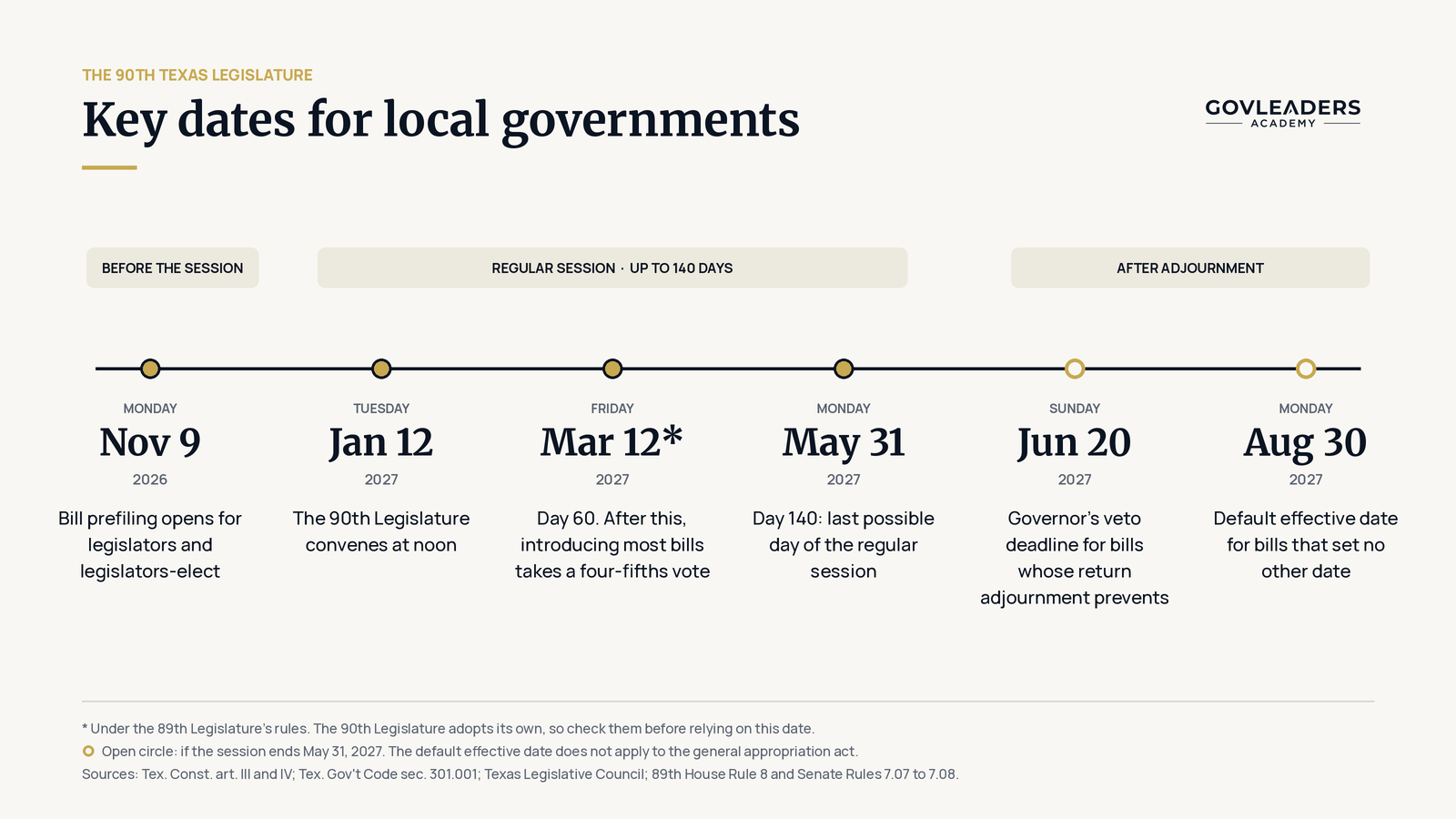
The opening date comes from statute and the 140-day limit from the constitution, so those two are fixed.2,11 Bill prefiling opens Monday, November 9, 2026.1 Day 60 falls on Friday, March 12, 2027; under the 89th Legislature's rules, introducing most bills after that took a four-fifths vote, with exceptions, and the 90th Legislature will adopt its own rules.12 If final adjournment is May 31, 2027, the governor's veto deadline for bills whose return is prevented by adjournment would be Sunday, June 20. For bills that set no other effective date, except the general appropriation act, the default effective date would be Monday, August 30.11
How to follow it
The official source is Texas Legislature Online, at capitol.texas.gov. You can look up any bill's text, history and committee, and search bill text for keywords or the number and wording of a code section you work under.13 A free MyTLO account lets you build bill lists and get email alerts when bills you follow see significant action, along with alerts for committee hearing notices.14 One detail worth knowing: email alerts are cleared before each regular session's prefiling period, so set yours up after prefiling begins.14 Your association is a good place to start, too; the Texas Municipal League, for example, reviews and tracks legislation for cities.15
Committee hearings are where a bill is most open to change. They're public, but testimony can be limited to invited witnesses, so read the hearing notice and the committee's rules for how to register a position or ask to testify.16
Before you change anything
Passage is one step. In 2025, House Bill 2520, another set of open meetings changes, passed both chambers and was vetoed on June 22, 2025, the last day of the veto period.17 Before you change a form or a policy, confirm the bill became law, read the enrolled text, and check its effective date and any transition rules. Many bills name their own date; HB 1522 named September 1, 2025.4 A bill passed by a two-thirds vote of all the members elected to each chamber can take effect immediately.11 Then leave your attorney time to review what passed. For a fuller grounding in how Texas government fits together, see Texas Government for Public Leaders: Structure, Authority, and Responsibilities.
Most of the work for local governments comes after the session ends: updating notices, budgets, policies and training, and telling the public what changed. The calendar tells you when that work is likely to start.
Reviewed against Texas law as of November 2026.
Want to cite this article?
GovLeaders Academy. (2026, November 7). The 90th Legislature: What to watch for local governments. https://learn.govleadersacademy.com/insights-the-90th-legislature-what-to-watch
“The 90th Legislature: What to Watch for Local Governments.” GovLeaders Academy, 7 Nov. 2026, learn.govleadersacademy.com/insights-the-90th-legislature-what-to-watch.
GovLeaders Academy. “The 90th Legislature: What to Watch for Local Governments.” November 7, 2026. https://learn.govleadersacademy.com/insights-the-90th-legislature-what-to-watch.
APA 7th edition
Sources (17)
- Texas Legislative Council, Dates of Interest (current PDF; lists the 90th Legislature prefiling and convening dates). https://tlc.texas.gov/docs/legref/Dates-of-Interest.pdf
- Tex. Const. art. III, sec. 5(a); Tex. Gov't Code sec. 301.001. https://statutes.capitol.texas.gov/Docs/CN/htm/CN.3.htm ; https://statutes.capitol.texas.gov/Docs/GV/htm/GV.301.htm
- Texas Municipal League, Legislative Update, June 13, 2025, Number 23, post-session summary. https://www.tml.org/DocumentCenter/View/5433/LU2025_23
- H.B. 1522, 89th Leg., R.S. (2025), enrolled version, Sections 1 to 3. https://capitol.texas.gov/tlodocs/89R/billtext/html/HB01522F.htm ; Tex. Gov't Code sec. 551.043, as amended. https://statutes.capitol.texas.gov/Docs/GV/htm/GV.551.htm
- House Research Organization, Texas House of Representatives, "Constitutional amendments proposed for the November 2025 ballot," Focus Report No. 89-4, July 28, 2025 (Proposition 9, HJR 1, and H.B. 9). https://hro.house.texas.gov/pdf/focus/amend89.pdf
- H.B. 9, 89th Leg., R.S. (2025), enrolled Sections 1 and 5; Tex. Tax Code sec. 11.145, as amended. https://capitol.texas.gov/tlodocs/89R/billtext/html/HB00009F.htm ; https://statutes.capitol.texas.gov/Docs/TX/htm/TX.11.htm#11.145
- Fort Bend Central Appraisal District, Business Personal Property, "Proposition 9 Passed: New Law for Texas Business Owners (as of 1.1.2026)"; Tex. Const. art. VIII, sec. 1(g), as amended November 4, 2025. https://www.fbcad.org/bpp/ ; https://statutes.capitol.texas.gov/Docs/CN/htm/CN.8.htm
- The Texas Tribune, "Texas GOP once again tries to ban local governments from hiring lobbyists in Austin," July 30, 2025. https://www.texastribune.org/2025/07/30/texas-taxpayer-funded-lobbying-2025/
- Texas Legislature Online, S.B. 19, 89th Leg., R.S., bill history. https://capitol.texas.gov/BillLookup/History.aspx?LegSess=89R&Bill=SB19
- Butler Snow LLP, "Texas Second Special Session: What Passed, What Stalled, And What's Next," September 16, 2025. https://www.mondaq.com/unitedstates/constitutional-administrative-law/1678506/texas-second-special-session-what-passed-what-stalled-and-whats-next
- Tex. Const. art. III, sec. 24(b) (140-day session), sec. 39 (effective dates and immediate effect); art. IV, sec. 14 (veto period). https://statutes.capitol.texas.gov/Docs/CN/htm/CN.3.htm ; https://statutes.capitol.texas.gov/Docs/CN/htm/CN.4.htm
- Texas House Rules, 89th Leg., Rule 8, secs. 7 (prefiling) and 8 (introduction after the first 60 days); Texas Senate Rules, 89th Leg., Rules 7.04 (filing), 7.07 (limitations on introduction) and 7.08 (exceptions). https://www.house.texas.gov/pdfs/resources/House-Rules.pdf ; https://senate.texas.gov/_assets/pdf/SenateRules89.pdf
- Texas Legislature Online. https://capitol.texas.gov
- Texas Legislature Online, MyTLO features (bill lists, bill alerts, committee hearing notice alerts; note on alerts and the prefiling period). https://capitol.texas.gov/MyTLO/BillList/BillList.aspx
- City of Anna, Memorandum No. 25-106, February 4, 2025 (Texas Municipal League bill review and tracking). https://www.annatexas.gov/Archive.aspx?ADID=1877
- House Research Organization, "How a Texas Bill Becomes Law," 89th Legislature (committee consideration; invited testimony). https://hro.house.texas.gov/pdf/focus/hwbill89.pdf
- Governor of Texas, veto proclamation, H.B. 2520, 89th Leg., R.S., June 22, 2025. https://lrl.texas.gov/scanned/vetoes/89/HB2520.pdf
Related courses

Related course
Texas Government for Public Leaders: Structure, Authority, and Responsibilities
Gain a clear working picture of how Texas government is organized, where public authority comes from and how state and local responsibilities connect.
8 contact hoursSelf-paced onlineView course

GovLeaders Academy is a division of GovLeaders Group LLC.
© 2026 GovLeaders Group LLC